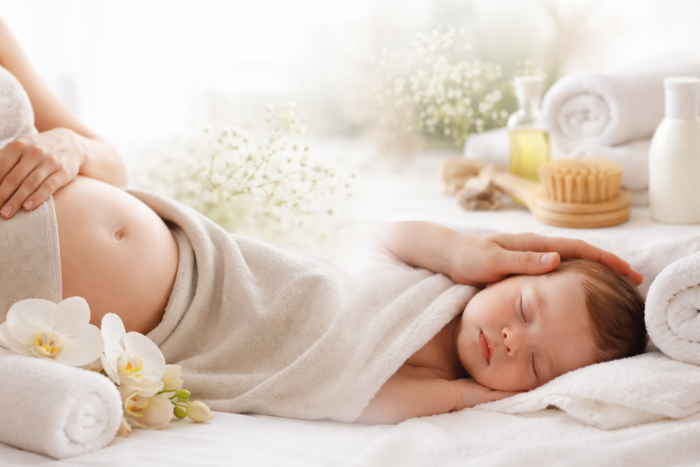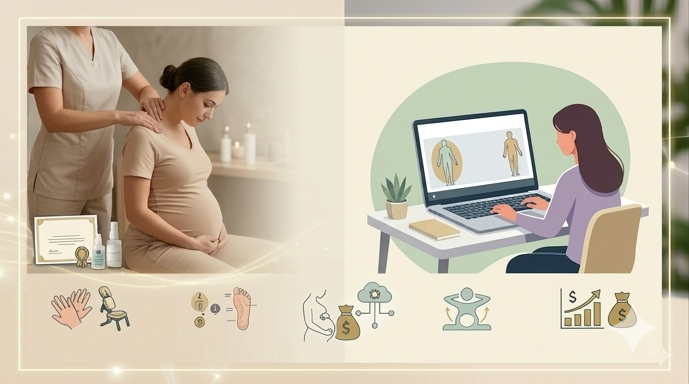
Pregnancy massage training Do you want to become a specialised massage therapist and offer a safe, tailored and professional treatment to expectant mothers? The prenatal massage training is designed to teach you all the necessary techniques, whether via distance learning with unlimited access or in-person over two days. This certifying course allows you to master the specific movements for prenatal massage, understand the physiological and psychological needs of pregnant women, and offer a relaxing and secure experience.
Thanks to this training course, you will be able to grow your business, attract a loyal customer base and offer top-quality professional services.
1. Why Follow a Professional Prenatal Massage Training Course to Specialize in Pregnancy Wellness Care?
Under eye rejuvenation is one of the most requested aesthetic treatments in international beauty salons and spas. The delicate eye area is prone to showing signs of fatigue, ageing, or dehydration. Pregnancy massage has become a essential treatment for pregnant women, because it allows:
- The reduce stress and muscle tension related to bodily changes,
- The stimulate blood and lymphatic circulation,
- d’improve sleep and emotional well-being,
- The relieve the back, legs and shoulders during pregnancy.
To practise safely and adapt the techniques to the different phases of pregnancy, it is essential to take a certificated training course.
2. Goals of a Prenatal Massage and Pregnancy Wellness Training Program for Future Therapists
La antenatal massage training aims to:
- Learn the Safe gestures and techniques for each quarter,
- Understanding the’anatomy and contraindications,
- Mastering the different prenatal massage protocols,
- Develop the trust and safety in professional practice.
3. Detailed Content of a Pregnancy Massage Training Course Available Online and In-Person
Distance learning
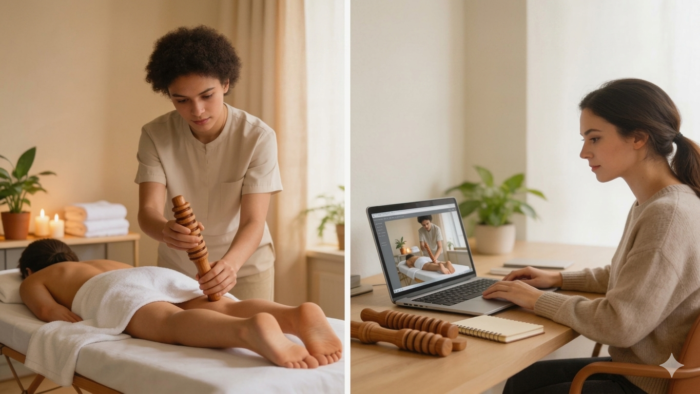
The version remotely (€199 with unlimited access) includes:
- Detailed videos of movements and positions,
- Explanatory sequences on anatomy and contraindications,
- Tutorials for back, leg, shoulder and stomach massage depending on the quarter,
- Guided practical exercises,
- Unlimited access to repeat the techniques as many times as necessary.
In-person training
Training In person (2 days, €599) near cities like Lille, Lens or Calais enables:
- Intensive practice on supervised models,
- Immediate feedback and correction of movements,
- Learning advanced techniques,
- Training certificate issued at the end of the session.
4. Techniques taught
During the training, you will learn:
- The gentle effleurage to relax the body without excessive pressure,
- The Targeted pressure on the back and shoulders to relieve tension,
- The Circular movements on the legs to improve blood circulation,
- The Gentle stretches tailored to each quarter,
- The mental and respiratory relaxation protocols for the mum-to-be.
5. Advantages of training
For the professional
- Develop an in-demand skill by institutes and individuals,
- Diversify the product range of care and attract a loyal clientele,
- Possibility of offering sessions in practice, at home or at work,
- Formation certifying, recognised by customers and employers.
For the client
- Relief of pain and muscle tension,
- Stress and anxiety reduction,
- Improvement of mobility and blood circulation,
- Moment of relaxation and overall well-being.
6. Target audience
This training course is for:
- Professional masseuses wishing to specialise,
- Beauty therapists wishing to add a prenatal treatment to their menu,
- New practitioners in wellness massage seeking a Certified qualification,
- Individuals interested in safe practice with those around them or their clients.
7. How does remote training work?
- Online registration on the platform,
- Access to Video modules and educational documents,
- Guided support from trainers via messaging or email,
- Repetition of techniques as many times as necessary thanks to unlimited access,
- Obtaining a certificate upon completion of the training.
8. Comparison with face-to-face training
| Criteria | In-person | Distance |
|---|---|---|
| Price | 599€ | 199€ |
| Duration | 2 days | Flexible, unlimited access |
| Practice | Framed with real models | Practical home exercises |
| Flexibility | Fix according to schedule | Available at any time |
| Interaction | Live with trainer | Online support |
9. Opinions and results
Our trainees share their experiences:
- “Thanks to this training, I've learned how to massage safely and my clients are delighted!” – Claire L.
- “The remote version is perfect for practising the movements and progressing at my own pace.” – Sophie M.
- “After the training, I was able to offer prenatal massages in my salon and increase my income.” – Camille R.
These returns show that the training is efficient, practical and cost-effective.
10. Further training: postnatal and baby
To broaden your range and offer complete follow-up:
- Postnatal Massage Training – 2 days face-to-face or €199 online, to support mothers after childbirth.
- Baby Massage Training – 1-day in-person or online €199, to learn the appropriate first aid for infants and strengthen the parent-child bond.
Discover all our specialised training courses to support mums and their babies:
[In-person antenatal class], [Remote Prenatal Training],
[In-person postnatal training], [Remote Postnatal Training],
[Baby Massage Course Face-to-Face], [Baby Massage Training by distance].
11. FAQ – Prenatal Massage Training
Q1 : Can I take the prenatal massage training remotely without prior experience?
Yes, absolutely. The training is specially designed to be accessible to both beginners and professionals. The detailed videos, step-by-step demonstrations and educational explanations make it possible to quickly understand the techniques and progress effectively, even without any background in massage.
Q2 : What is the ideal duration to take the distance learning course?
R: There is no set time limit. Thanks to unlimited access, you can work at your own pace: some people finish in a few days, whilst others take several weeks to train and perfect their technique.
Q3 : Does the training lead to a qualification?
Yes. A training certificate or attestation is issued after validation of the modules. This allows you to showcase your skills to your clients and enhance your professional credibility.
Q4 : Can prenatal massage be performed on all pregnant women?
A: In the majority of cases, yes. However, certain contraindications do exist (high-risk pregnancy, medical complications, medical advice required). The training teaches you to identify these situations in order to practise safely.
Q5: From which month can prenatal massage be performed?
Prenatal massage is generally recommended from the 2nd trimester onwards. The training explains how to adapt the movements according to each stage of pregnancy.
Q6 : What are the benefits of prenatal massage?
R: The benefits are numerous:
- Reduced stress and anxiety
- Lower back and muscle pain relief
- Improvement of blood circulation
- Reduced heavy legs
- Sleep improvement
This is a treatment that is very popular with expectant mums.
Q7 : What is the difference between distance learning and face-to-face learning?
R :
- Remotely flexible, economical, unlimited access
- In-person supervised practice, immediate feedback, immersion
Both formats are complementary depending on your needs.
Q8 : How much does a prenatal massage training course cost?
R: Distance learning courses are often accessible for around £199, whereas classroom-based courses can cost approximately £500 to £600 depending on the duration and level of support.
Q9: Can the training course be made profitable quickly?
R : Oui. Une séance de massage prénatal est généralement facturée entre 60€ et 100€. Avec seulement 2 à 4 clientes, vous pouvez amortir votre formation.
Q10 : Peut-on proposer le massage prénatal à domicile ?
R : Oui, c’est même une prestation très demandée. Les femmes enceintes apprécient particulièrement le confort de recevoir un soin chez elles. Il suffit d’avoir une table de massage adaptée et de respecter les règles d’hygiène.
Q11 : Quel matériel est nécessaire pour débuter ?
R : Le matériel de base comprend :
- Une table de massage confortable
- Des coussins adaptés pour la femme enceinte
- Une huile de massage naturelle
- Des serviettes propres
L’investissement reste accessible.
Q12 : Combien de temps dure une séance de massage prénatal ?
R : Une séance dure en moyenne entre 45 minutes et 1 heure. Cela permet de travailler les différentes zones du corps tout en respectant le confort de la cliente.
Q13 : Le massage prénatal est-il dangereux ?
R : Non, s’il est pratiqué correctement. La formation vous enseigne les gestes sécurisés, les zones à éviter et les adaptations nécessaires pour garantir un soin sans risque.
Q14 : Comment attirer ses premières clientes ?
R :
- Publier du contenu sur Instagram et Facebook
- Proposer une offre découverte
- Collaborer avec des sages-femmes ou professionnels du bien-être
- Mettre en avant les bienfaits du massage
Le bouche-à-oreille fonctionne très bien dans ce domaine.
Q15 : Le massage prénatal fidélise-t-il la clientèle ?
R : Oui, fortement. Les clientes reviennent régulièrement pendant leur grossesse, puis après avec des soins postnataux ou pour bébé. Cela permet de créer une relation durable.
Q16 : Est-ce une bonne activité complémentaire ?
R : Oui. Le massage prénatal est une prestation premium qui permet :
- d’augmenter votre chiffre d’affaires
- de se différencier
- d’attirer une clientèle spécifique
Q17 : Peut-on en faire une activité principale ?
R : Oui. En combinant massage prénatal, postnatal et bébé, il est possible de créer une activité spécialisée autour de la maternité.
Q18 : Quelle est la différence entre massage prénatal et postnatal ?
R :
- Prénatal : pendant la grossesse, adapté aux besoins de la future maman
- Postnatal : après l’accouchement, axé sur la récupération du corps
Les deux sont complémentaires.
Q19 : Faut-il une assurance pour pratiquer ?
R : Oui, il est recommandé de souscrire une assurance professionnelle pour couvrir votre activité, surtout si vous travaillez en indépendante.
Q20 : Peut-on se lancer rapidement après la formation ?
R : Oui. Avec de la pratique et une bonne maîtrise des gestes, vous pouvez proposer vos premières séances en quelques jours seulement.
Q21 : Quels sont les avantages d’une spécialisation maternité ?
R : Se spécialiser dans les soins maternité permet :
- de se positionner sur un marché spécifique
- d’attirer une clientèle ciblée
- de proposer des prestations à forte valeur ajoutée
Q22 : Le massage prénatal est-il demandé toute l’année ?
R : Oui, la demande est constante. Les grossesses ont lieu toute l’année, ce qui garantit une activité régulière.
Q23 : Peut-on combiner ce massage avec d’autres soins ?
R : Oui, vous pouvez proposer des offres combinées :
- massage + soin visage
- massage + réflexologie
- massage + relaxation
Cela augmente le panier moyen.
Q24 : Quels sont les profils de clientes ?
R :
- Femmes enceintes stressées ou fatiguées
- Futures mamans souffrant de douleurs
- Clientes recherchant un moment de détente
- Femmes souhaitant un accompagnement bien-être
You can also read: